Maintenance Agreements That Run Themselves
Recurring revenue is only valuable if it does not need chasing. How agreement tiers, separate billing and service intervals, a no-password customer portal and automatic review requests fit together.
- Recurring revenue is only valuable if it does not need chasing. How agreement tiers, separate billing and service intervals, a no-password customer portal and automatic review requests fit together.
- Where AirMatch can make the proposal process clearer for homeowners.
- Practical ways to protect momentum from consultation to signature.
Maintenance Agreements That Run Themselves
Every HVAC owner knows maintenance agreements are the most valuable thing they sell. Recurring revenue, first call on a replacement, a customer who does not shop around every time something rattles.
And almost every HVAC owner has the same quiet problem with them: the agreements are sold, and then nobody is quite sure which visits are due, who has been billed, or how many lapsed last year without anyone noticing.
The value of a maintenance program is entirely in the follow-through. Here is how AirMatch handles that part.
Three levels, and you name them
Agreements are structured in three levels: the brand, the plan tiers, and the individual customer subscription at a specific service address.
The tiers are yours to define. Name them whatever your company uses — Essentials, Gold and Platinum, Silver and Gold, Comfort Club, whatever is already on your truck. Each tier carries its own price, service intervals, appointment length and checklists.
That last one is worth pausing on. Attach a checklist to a tier and every visit under that tier carries it automatically, forever. The standard travels with the agreement rather than with whoever happens to be assigned that week.
Term lengths are configurable too — one, two or three year pricing — and individual tasks within a plan can be toggled on and off and priced, so you can shape what is included rather than accepting a preset.
Bill monthly, visit annually
This is the detail that trips up most software and most contractors.
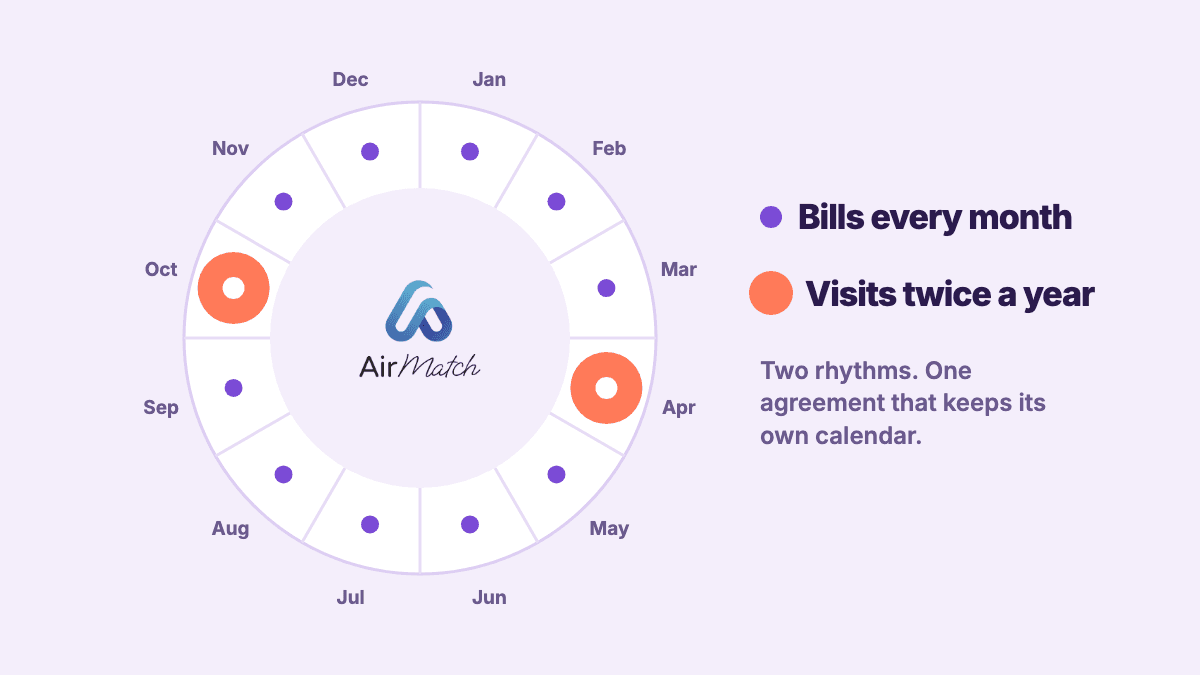
Billing interval and service interval are separate settings in AirMatch. You can charge $12 a month and visit once a year. They do not have to align, and in practice they usually do not, because monthly billing is easier for the homeowner to say yes to while annual service is what the equipment actually needs.
Recurring billing runs through Stripe on your own connected account. Standard Stripe processing rates apply to transactions and AirMatch adds no markup on top of card processing.
Knowing what is due
One grid shows what is coming: client, address, program, interval, status, price, payment health, visit status, due-by date, last serviced, and revenue to date — with live Stripe data in the detail view.
Payment health next to visit status is the combination that matters. A customer whose card failed three months ago and who is due a visit next week is a problem you want to find before the technician is in the driveway, not after.
When a visit is done, you mark the service as performed — annual service for 2026, say — and that sets the service date so the system knows the visit for that period is complete.
The customer side
The customer portal needs no password. That one decision removes most of the reason customer portals go unused.
It opens on a needs-your-attention strip of verb-first cards — “Pay $412”, “Review and sign” — so the single thing the customer has to do is impossible to miss. They can pay an invoice by card, review and sign documents, and self-schedule their own appointments.
Self-scheduling is worth more than it looks for a maintenance program. The annual tune-up call is a low-value, high-volume task for your office. Letting the customer book it themselves turns that from a phone call into a notification.
Reviews, while they are still happy
The best moment to ask for a review is immediately after the work, and the hardest time to remember is immediately after the work.
Review requests go out automatically after the job. And since July 2026 you can connect Google and Facebook to read and reply to reviews from inside AirMatch, rather than logging into two more places you do not check often enough.
For a maintenance base, this compounds. Every visit is a prompt. A company doing a few hundred maintenance visits a year has a few hundred natural opportunities to ask, and almost none of them survive relying on memory.
Selling it at the table
One more thing worth knowing: service plans are presented beside the replacement system in the proposal. The maintenance agreement gets sold at the same table as the equipment, while the homeowner is already making a decision, rather than in a follow-up call that often does not happen.
That is usually where attach rate comes from. Not from a better pitch later, but from asking during the conversation that is already going well.
What to check in your own numbers
If you want to know whether your maintenance program is actually working, three figures tell you most of it:
What proportion of replacements leave with an agreement attached?
How many agreements lapsed last year, and did anyone notice at the time?
What is the revenue to date on your oldest tier, against what it should have been?
If you cannot answer those quickly today, that is the gap worth closing — before worrying about which tier names to use.
Practical guidance from the team building proposal, sizing, financing, signature, and payment workflows for residential HVAC contractors.
Ready to build HVAC proposals homeowners actually understand?
See how AirMatch helps contractors present Good / Better / Best options, collect signatures, show financing, and keep every sales conversation moving.